Machine Learning for Prediction of HDD Drill Rod Failure – What is Possible?
Let’s talk about something that sounds way more complicated than it actually is — machine learning for HDD drill rod failure prediction. I do technical sales in the drill rod business for five years, which is a fancy way of saying I get lots of calls from contractors who are having a very bad day. I am not a data scientist. I’m the guy who asks “What were your torque and mud flow doing right before it twisted off?”
And I’ll be honest, when I first heard the term ‘machine learning’ in the HDD space, I rolled my eyes. Sounded like a guy trying to sell a smart coffee mug. Then I had a little eureka moment.
A contractor phoned me last spring. They had three rod failures in one river crossing. Same job, same crew, same rig. They were ready to lay the blame on our steel. Fair enough, I would blame the steel too if I were them. We pulled the rig data . Torque was going nuts during pullback through cobble.
RPM held steady. Mud flow wasn’t as good as I like.
The rods were not defective. They were being killed by stick-slip and heat. If someone had noticed that pattern after the first failure, they might have saved the second and third. That was the moment of realization: ML is not magic. It’s a way to see the pattern before the rod sees you.
But what can we actually do? Here’s the shop-floor version, not the TED talk.
What ML is capable of?
- Flag “this looks like the last time.
If you feed a model torque, thrust, rpm, mud pressure, vibration, rod serial number, hours, geology and failure records it can learn what a bad pull looks like. Then it can tell you, “Hey, this is the same signature as the joint that cracked on the Smith job.” That is detecting anomalies. It’s not a crystal ball, it’s useful. - Rank rods according to risk.
Not all rods are made equal. Some have 20,000 feet on them, some rethreaded, some in corrosive soil, some run by an operator who thinks make-up torque is a suggestion. You can combine that into a risk score with a model. You still choose, but you don’t guess. - Remaining useful life (rough estimate)
I say roughly, because fatigue is a messy thing. But if you record cumulative loads, bend cycles, thread wear and inspection data, ML can give a better estimate of “probably retire this one before the next critical crossing” than “it’s got about two more jobs in it.” - Learn from every mistake.
Every twistoff is information. If you log it right – where, what geology, what torque, what rod, what joint – then a model can help you stop repeating the same expensive mistake. That’s the real win.
What machine learning cannot do?
Here is where I need you to not get caught up in the hype. ML can’t tell you which rod will fail at 3:47 PM on Tuesday. Bad data can’t be fixed. It will not save a cheap rod from a bad pull. And it can’t magically know your rods if you don’t know your rods.
“If you don’t serialize your rods, track hours, record inspections and log failures, there’s nothing to learn from. Garbage in, garbage out. Also, HDD is brutal and variable. A model trained on one rig in Texas sand is not going to be perfect on a rig in Alberta rock.” You have to think on the risk, not the certainty.
Things You Can Do Today
You don’t need a team of data scientists to begin. You need a habit.
Put a serial number on each rod.
Basic usage tracking: job, rig, geology, footage, hours, torque, thrust, rpm, mud flow
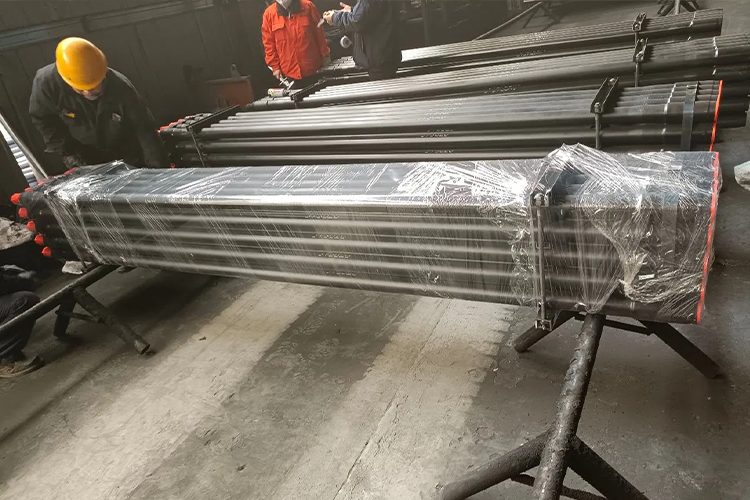
Check threads and O.D. Write it down. Take pictures.
Tell the story when a rod failed. What were you doing? What did the rig data say? What did the thread look like?
Begin with a spreadsheet. If you see patterns, that’s cool. And if you want ML down the road you’ll actually have data to feed it.
I know, that sounds boring. But the aha moment isn’t a robot telling you your rod is about to break.” The aha moment is realizing you already have the clues, you’re just not capturing them.
My true opinion
I am a drill rod guy and I don’t think ML will replace the old driller who can hear a rig change tone. I think it’ll do him some good. Another eyes. The best use is not “predict every failure. It’s “stop the stupid ones” and “no questionable rod on the million dollar crossing.
So, if you are a contractor, ask yourself: what data do I already have? If you’re a manufacturer, ask how can we make rods easier to identify and track? We’re all still learning this.
So next time you get a torque spike in cobble, don’t blame the steel alone. Look at the numbers. That’s the first step. And if you want to talk drill rods, thread compounds, make-up torque or failure analysis, you know where to find me. Just shop talk, no pitch.
SHARE:
More Posts for You
- Machine Learning for Prediction of HDD Drill Rod Failure – What is Possible?
- How bad can a dogleg be ? HDD drill rod fatigue : what are the safe limits ?
- HDD Drill Rod Steel Price Impact on Costs: 2026 Market Outlook
- OEM vs Aftermarket HDD Drill Rods: Warranty, Liability & Performance
- How a Bent Sub or Worn Saver Sub Impacts Your Whole Drill Rod Inventory
- How Much is Your Old HDD Drill Rod Worth for Scrap? (Current Pricing Knowledge)
- 7 Deadly Sins of Handling HDD Drill Rods: Dropping, Dragging, Over-Speeding
- Urban Utility Drilling: Why Shorter, Stiffer HDD Drill Rods Are Often Better