How Much is Your Old HDD Drill Rod Worth for Scrap? (Current Pricing Knowledge)
I’ll tell you about the day I saw a guy load twelve rods on a flatbed and drive off with a check for $340.
I was at a yard in Texas visiting a customer, a small directional drilling outfit, 2 rigs, family run. Finally, he had decided to get rid of a rack of bent and battered rods that had been stumbling all over themselves in the corner of his lot for three years. They called a local scrap guy, weighed the load and that was it. Three hundred and forty dollars. He looked almost relieved.
I remember, I was here and I thought, Man, there’s a story in those rods that just walked out the gate.
Not necessarily a sad story. But a story about the difference between what we think worn-out drill rod is worth and what it really is.
Let’s talk about that gap.
The real story behind drill rod scrap prices
Here’s the thing no one tells you when you are staring at a rack of dead rods: your drill rod isn’t “drill rod” to a scrap yard. It’s just molten steel, it’s heavy.
That’s all. That’s the entire game.
Scrap yards buy by weight and by grade, not by what the steel was doing for a living. Your 3 ½-inch forged rod with the beat-up shoulders? Same category as a piece of I-beam from a warehouse that was torn down. The yard doesnt care that it used to drag a 40,000 pound reamer through cobble. It cares about how many pounds of clean, dense steel you are dropping off.
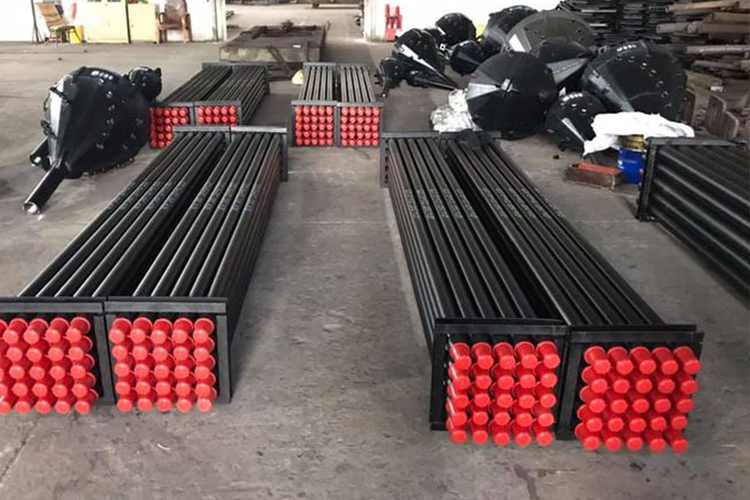
As of mid-2026, the #1 Heavy Melting Steel (HMS) grade benchmark is trading at around $374 per ton across the U.S. That’s about as close to a “list price” as you’ll find for what your rods are worth as scrap. Some areas are a bit higher – the South at around $388, the North Midwest closer to $365. It moves around from month to month, but it’s been pretty steady for the majority of this year.
So say you have, oh, 2000 lbs of worn out rods. A ton. You’re looking at somewhere in the neighborhood of $370-$390 at the yard, before any deductions.
And there are always deductions
The part where I had my own little epiphany.
I was helping a client clean out a job site a couple of years ago. He had some 6,000 feet of used 2 ⅞-inch pipe that was too far gone to be rethreaded or reused. “What’s this stuff worth?” he asked me, half joking. A few thousand?’
I added it up in my head. Standard weight 2⅞” drill pipe weighs approximately 7.9 pounds per foot. Make it 8 pounds, just to be sure. Times 6000 feet. That’s 48,000 lb. Twenty-four tons:
That’s about $8,976 at $374 a ton.
He looked at me like I’d just told him his truck was a Ferrari with a wig on.
“But I paid a whole lot more for it,”
Yeah. Yes you did. And that’s the thing about drill rod – it loses value the moment it leaves the factory floor, and once it crosses the threshold into “not safe to run anymore,” it doesn’t matter what you paid for it. It is just steel.
My little epiphany was that the scrap value of drill rod is almost always shockingly low compared to what people think it is. Not that the scrap yards are lying. Drill rod is a highly engineered consumable and once the engineering is consumed, what remains is the raw material. And the raw material is cheap.
How to actually work out what you’ve got
You do not need a degree in metallurgy to ballpark this. Three numbers are required:
- Total weight of your rod(s). All manufacturers list weight-per-foot specs. Mini-class rods are light and 6 to 10 feet long, often in the 8 to 12 pound per foot range. Medium 3 ½-inch rods typically run 14 to 18 lb/ft. If you’re running 5″ or bigger your in the 22-30 lb/ft zone. Multiply by total footage and you have your weight. If you want to be thorough, add maybe 5% for tool joints – those heavy ends add up.
- Current HMS price where you are. The RMDAS index is published monthly and is available by region. It is free to search. The national average for #1 HMS is $374 per gross ton as I write this.
- Deductions your yard will nail you for. This is where it gets a little less precise. If your rods are bundled with non-ferrous hardware, if they’re painted with thick coatings, if they’re unusually long and need cutting down, the yard might knock the price down. Some yards will not accept rod longer than 4 feet without a cutting charge. Book. Ask Your Educator
Let’s make this concrete with a quick example:
20 rods each 10 feet = 200 feet
3 1/2″ rod at ~16 lb/ft = 3,200 pounds
At $374/ton = around $598
Twenty rods.” Six hundred dollars. That’s a good feed for the crew. It’s not a new rod set.
The unpleasant math: scrap vs. “still has life”
Here’s the part where I get a little preachy, because this is where it really matters.
A worn out rod isn’t binary. It’s neither “perfect” nor “scrap.” There is a whole gray zone in between. Rods too worn to run on a production job but still valuable to somebody.
Used mini-class rods do trade on the secondary market in the $100–$175 per rod range. That’s not the scrap rate. Those are prices for used equipment. And there’s a real market for it — little contractors, rental yards, guys doing light utility work who don’t need premium-class pipe.
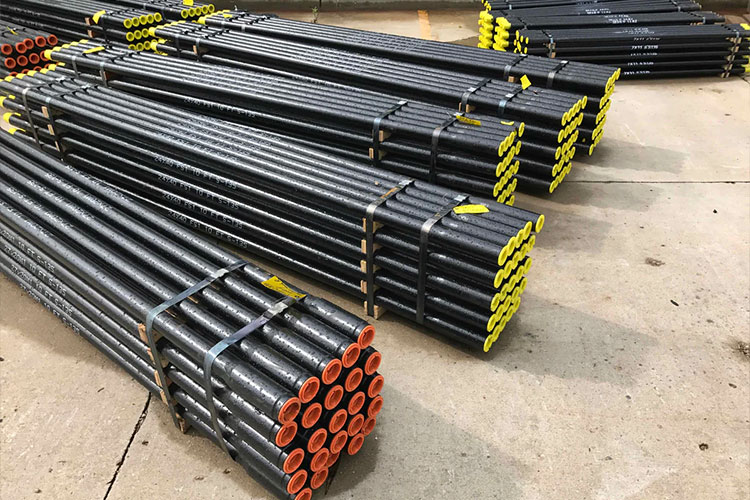
So when you’re looking at a rack of “dead” rods, ask yourself this:
Are any of these actually still in spec for light duty work?
Any smaller operator in the area that would buy them at 3x scrap value?
Are the tool joints good enough to bother cutting off and selling?
I’ve seen guys ditch $150 rods each as used pipe and get $30 each at the yard. That’s not a pricing problem. This is a decision problem.
The floor is scrap. It’s the very least you could do. And it should be the last resort, not the first call.
What I Really Tell Customers
If anyone asks me “What’s the value of my worn-out rods in scrap?” here’s my honest answer:
If they’re truly dead — bent, cracked, wall thickness beyond 15% — then they are worth what HMS is trading at in your area minus whatever your yard decides to charge you to handle them. That’s roughly $370-$390 a ton today. Per ton, not per rod.
If there’s any life left, don’t throw ’em out. You can sell them as used.
And if you don’t know which category they belong to? That’s the point of the inspection.” Drill rod should be scrapped when wear on wall thickness is over 15%, when local bending is over standard, or when welds have defects. If your rods don’t meet those thresholds, they are not scrap. Inventory they are.
They will always go to the scrap yard. That’s the easy route. The tougher question — the one that actually puts money back in your pocket — is whether they have to leave.
SHARE:
More Posts for You
- Machine Learning for Prediction of HDD Drill Rod Failure – What is Possible?
- How bad can a dogleg be ? HDD drill rod fatigue : what are the safe limits ?
- HDD Drill Rod Steel Price Impact on Costs: 2026 Market Outlook
- OEM vs Aftermarket HDD Drill Rods: Warranty, Liability & Performance

- How a Bent Sub or Worn Saver Sub Impacts Your Whole Drill Rod Inventory
- How Much is Your Old HDD Drill Rod Worth for Scrap? (Current Pricing Knowledge)
- 7 Deadly Sins of Handling HDD Drill Rods: Dropping, Dragging, Over-Speeding
- Urban Utility Drilling: Why Shorter, Stiffer HDD Drill Rods Are Often Better