HDD Drill Rod Buying Guide: 7 Factors You Must Check Before You Buy
Hello friend.
Sit down. Or better, wipe the mud off your boots, get a cup of coffee and let’s have a real talk.
I’ve been in the trenchless world for about 5 years now, working on the factory floor of a drill rod manufacturer. Prior to that? I was on your side of the fence running rigs, cursing stuck pipe and praying that the “good deal” I got on rods wouldn’t break in half half way through a 500 foot bore under a highway.
Spoiler alert: It usually did.
I learned more about HDD drill rods the hard way than I did from a spec sheet. If you’re looking for new rods, whether you’re a one-rig operation or you’re stocking up for a fleet, I want to walk you through the stuff that matters. Not the marketing bullshit. Not the “our steel is the best steel” drivel.
7 Things I Personally Check Before I Put A Single Piece Of Pipe On My Truck. Let’s Talk. And yeah, I’ve got some scars of war to share along the way.
The “Feel” Test about HDD Drill Rod (Don’t Trust the Paint Job)
Funny thing is this Looks great with a shiny green or orange rod. It’s like a candy apple. And for a second you think, “Man, this is quality.
Then you grab it.
My first “aha” moment: weight does not equal strength, but balance tells you everything.
I recall buying a bunch of rods from a supplier who was big on “heavy-duty alloys.” They felt heavy, yes. But they were nose-heavy. The pin end was thicker than the box end, the whole thing felt like a sledgehammer. Making up joints in the dirt is that imbalance that will wear out your threads faster than you can say fishing job.
So my rule? Keep the rod level. If it feels like it’s fighting gravity more in one spot than another, walk away. “The weight distribution tells you how well the tube is pulled. It’s a gut check, but I believe it.”
HDD Drill Rod ‘Threads’ (Where My Nightmares Live)
I want to tell you about a Tuesday in 2022. I was on location with a customer that was pulling back a 6″ gas line. His rod broke off at the connection, 400 feet in. A crumpled soda can was the look of the thread.
His words? But the threads were double-dyed!
Yeah. You can’t fix bad geometry with coating.
Here’s what I geek out on: the thread root radius. Fancy word, I know. But basically, it’s the little curve at the bottom of the tread. If that curve is too sharp, you get a stress point. It’s like that little dent in a soda can tab—you know it’s going to pop.
I don’t care if a sales rep tells you they have ‘proprietary thread technology.’ I care about wear patterns. I always ask to see a sample that has been used. What does the thread look like after 500 cycles? Is it smooth and well finished or is it full of micro-cracks?
Short story: I once had a customer who bought the cheapest rods he could find. I looked at his threads after a month. They looked like jagged teeth. He did more filing with a thread chaser than he did drilling. That’s not savings, that’s a side hustle.
HDD Drill Rod Steel Grade (But Not How You Think)
Everyone says, “It’s 4130 chromoly!” like it’s the magic word to make them invincible.
Here’s my hot-take: The steel grade doesn’t matter so much as the heat treatment.
I’ve seen cheap 4130 out-perform expensive 4140 because the heat treat was uniform. What you need is a rod that is hard on the surface to resist wear, but soft in the core so that it bends without breaking.
Think of it like a good bread stick. Crunchy on the outside, chewy on the inside. Hard all the way through? snap That is a brittle failure and you are going to be pulling a fish tape through a borehole that looks like a crime scene.
Always ask: “What is your hardness range and how do you test it? If they can’t give you a specific Rockwell number (like 28-32 HRC) and just say “it’s hard,” run. They are guessing And guess what? It costs you $10,000 down time.”
The “Fat” Part of the Hdd Dril Rod ( The Upset)
Okay, now I sound like a complete nerd. But hang in there.
The upset is the thick, swollen part of the pipe where the threads are. This is where the tube gets wider.
I see guys buying rods with such a long upset it adds 10 extra pounds to every joint. You think, “It’s just steel, who gives a shit?”
I care because that weight has to be spun on your drill rig. “And that weight at the ends? It makes vibration. And vibration kills bearings, kills your topdrive and makes your rod handler want to kill you.
My golden rule: Find an upset that is just long enough to carry the thread, but not an inch more. It’s a balancing act. My mentor in the shop, an old guy named Chuck, used to say, “A fat rod is a lazy rod. ” easier for the factory to make but less easy for you to operate. Chuck was a grumpy guy but he was right.
The Straightness Test (The ‘Eye-Ball’ Test)
You’d think a new rod would be straight, wouldn’t you?
No.
I’ve opened a pallet of rods from a big name brand and they looked like spaghetti. I measured them and they were 1/8″ over 10′. “That’s within spec,” the sales rep said.
“Not my spec,” I answered.
If the rod is not straight within .03″ per foot, you are drilling an oval hole. It swings. It hits the side of the hole. This increases your torque.
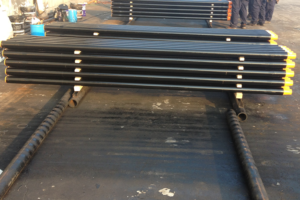
When the delivery arrives I pick up a rod, put it on two sawhorses and spin it. I see the end. I toss the whole thing if it moves more than a couple of millimetres. Shipping department, I don’t care if you are mad at me. Your straight rod just cost me a reamer.
The Manufacturer’s “Repair Policy” (The Secret Snare)
Here’s a subject that nobody ever talks about: What happens when you do break one!
You will. I don’t care how cautious you are. You’re going to hit a rock or an operator is going to have a bad Monday and a rod is going to break.
“What do you charge to rethread or fix a broken rod?” Ask this question right up front.
Just to put you off – I know one supplier who charges an arm and a leg for repairs. Another vendor I work with charges a flat rate almost the cost of a new rod.
But then we have the 3rd type, the ones I actually like. They will repair it for cost and give you a loaner rod while yours is in the shop. That’s a partner, not a supplier.
I had a customer call me in a total freak out because he broke a rod on a Friday afternoon. The other supplier would not even pick up the phone. We sent him a replacement from our demo stock to tide him over the weekend. I’ve been a loyal customer ever since. Not that our rods were invulnerable, but we had his back.
“The Dock Test” (my favourite)
You want the most practical advice I can give?
First, buy a box.
I don’t care if you get 20% off for buying 500 rods. Buy 30. Run.
So what I do is, I put them on my toughest job. Not a 100-foot shot in the sand easy. I put them down in clay, with gravel. I push the envelope.”
Why? Because I want to see the wear pattern after 10, 20, 50 connects.
Are the threads frayed?
Is the paint peeling?
Are the connections breaking faster than you thought?
A lot of guys go out and buy a whole tub of rods because of a flash sale. I’ve seen those guys cry. Literally crying in a port a potty because they bought 200 garbage rods that don’t fit right.
Try them out. Good factories ? They will send you a free sample box. If they don’t give you that, they’re hiding something.
Real Talk
Look, at the end of the day a drill rod is just a tube of metal. But it’s the lifeblood of your operation. It’s what’s linking your machine to the hole in the ground.”
I’m not trying to sell you on that my rods are the best. And I’m here to tell you if you buy rods without checking these 7 things, you’re gambling. And I ain’t never been a gambling man, not until there’s a cold beer on the line.
So next time you’re flipping through listings or talking to a smooth-talking rep, just remember: Weight means nothing. Coating of thread is nothing. Some fancy name on the side of the box doesn’t mean anything.
The important thing is that you have confidence that when you hit that throttle, the pipe’s going to follow you, the guy on the ground.
If you ever have a question, or if you just want to send me a picture of a gnarly thread to get my opinion, I’m always down.
Now go and check your torque. And for the love of mud, lube those threads well.
- The “Feel” Test about HDD Drill Rod (Don’t Trust the Paint Job)
- HDD Drill Rod ‘Threads’ (Where My Nightmares Live)
- HDD Drill Rod Steel Grade (But Not How You Think)
- The “Fat” Part of the Hdd Dril Rod ( The Upset)
- The Straightness Test (The 'Eye-Ball' Test)
- The Manufacturer's "Repair Policy" (The Secret Snare)
- “The Dock Test” (my favourite)
SHARE:
More Posts for You
- Machine Learning for Prediction of HDD Drill Rod Failure – What is Possible?
- How bad can a dogleg be ? HDD drill rod fatigue : what are the safe limits ?
- HDD Drill Rod Steel Price Impact on Costs: 2026 Market Outlook
- OEM vs Aftermarket HDD Drill Rods: Warranty, Liability & Performance

- How a Bent Sub or Worn Saver Sub Impacts Your Whole Drill Rod Inventory
- How Much is Your Old HDD Drill Rod Worth for Scrap? (Current Pricing Knowledge)
- 7 Deadly Sins of Handling HDD Drill Rods: Dropping, Dragging, Over-Speeding
- Urban Utility Drilling: Why Shorter, Stiffer HDD Drill Rods Are Often Better