Best Practices for Storing Drill Rods: Keep Your Inventory Safe From Rust and Damage
You know that sinking feeling when you take a rod out of the rack and your thumb catches on a rough spot just below the thread? And you can tell before you’ve even wiped it off that it’s rust. Not the cute surface fog that you can wipe off with a rag. I mean the kind that looks like a pitted, orange-crusty face that makes you want to throw your hard hat across the yard.
Been there done that. I’ve done that. Got the T-shirt (and the call from the project manager, angry).
I’ve spent the last 5 years in a drill rod factory, not just selling the stuff, but watching how guys treat it – good, bad and ugly. And I’ll be honest, the “bad” and “ugly” usually come into play way before the rod ever sees mud. They start in the storage yard, the shed, or that dank corner of the warehouse where everybody puts things they don’t want to deal with.
So, let’s talk. Not like, I’m your high school shop teacher wagging a finger. More like I’m the buddy that has witnessed too many 800 dollar rods become 50 dollar scrap metal and wants you to avoid that heartburn.
The Oh Crap Moment That Changed My Mind About Storage
Early in my sales career, I went out to see a customer who had a really nice fleet of rigs. Top-shelf machines, well-maintained, clean cabs. But in the rear? Their collection of rods was like a shipwreck. Pipes on gravel. Last jobs’ ends, never cleaned, mud-covered. Thread protectors? Ha—half of them were missing, the other half were cracked plastic cups that wouldn’t keep a housefly out.
The foreman pointed to a section 15 feet long. “This one’s only two months old,” he said. I got down on my knees and ran my glove down the end of the box and my finger went almost through a rust crater. Two months. He shrugged. “We keep them outside. Always did.
That was my moment of light bulb. Not because he was lazy, he wasn’t. He had plenty to occupy him. He was moving dirt, making hole, chasing production.” Storage wasn’t on his radar until a rod snapped in the bore and they spent three days fishing it out. Then he began to listen. And I started to watch how I talked about storage more and more with each new customer.
Because here’s the dirty secret: rust doesn’t care how much your rods cost. It doesn’t care about your schedule, your budget. All it requires is moisture and oxygen and a little neglect. And if you give it those three things, it’ll eat your profit margin for breakfast.
Elevated Racking – More Than Just Looks
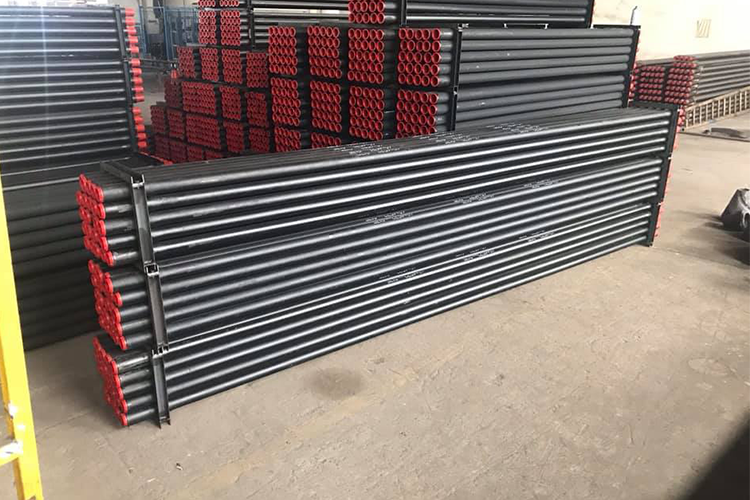
Contact with the ground is the enemy. End of story. I don’t care if you have a concrete pad or compacted dirt, if your rods are laying flat on the surface you are basically inviting groundwater to wick up through the steel. And don’t even get me started on the scratches from dragging them over aggregate. Those little gouges are rust’s favourite front door.
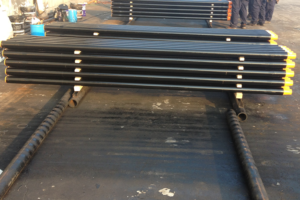
What I do at my own little shop (what I nag at every client about) is simple: get them up. At least 12″ off the floor. Any wooden sleepers, steel sawhorses, old conveyor belting, whatever you have. Place supports every 4 to 5 feet to keep the rod from sagging. A bent rod is a weak rod and weak rods like to snap just about the time you’re 200 feet down in sandy clay.
I know a guy that uses old tyre rims with plywood on top. Ghetto ? Yeah. But it works and it’s next to nothing. You’re not trying to be fancy you’re trying to break that capillary action between the steel and the wet ground.
The Gospel of the Thread Protector (Yes I’m Preaching)
Well, time for me to get on my soap box. Thread guards are not optional accessories. They’re not “nice to haves.” They’re the condoms of the drill-rod world–you don’t cut corners on them unless you want a nasty surprise later.
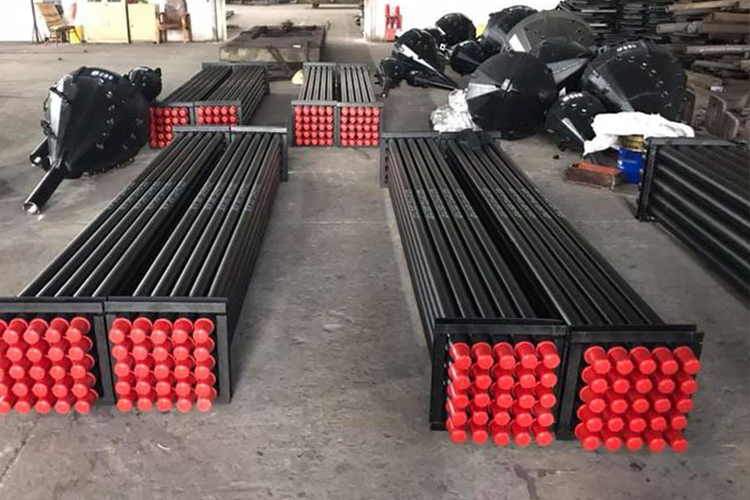
I don’t know how many times I’ve been out in a yard and seen guys screw those cheap plastic caps on and they’re cracked, or they don’t fit tight, or they’re just shoved on backwards. That’s like wearing a raincoat with holes in it. Moisture gets in, sits in the thread root, and next thing you know, you’re torquing up a connection and it feels “gritty”. That gritty feeling is metal eating itself.
Buy good quality, heavy duty thread protectors – O-ring sealed if you can afford them. And teach your crew how to clean the threads before they put the protector on. I’ve seen guys take a dirty protector and spin it over a muddy thread and basically sand paper the crests flat. Now you’ve got a loose connection leaking mud and robbing your thrust.
My rule of thumb: treat every thread as if it’s the last one you’ll ever have. Because you’ll wish you did, when that pin shears off downhole.
Cover them but let them breathe
Tarps are a bitch. I have had customers proudly show me their rods all wrapped up in heavy-duty canvas, snug as a bug. And then I lift a corner and it stinks like a swamp under it. City of condensation.
Learned the hard way that if you cover rods, you need to leave the ends open to allow air to move through. A tight seal traps the daytime heat and when it cools at night that trapped air dumps moisture right on the steel. You’re basically creating a mini-rainforest for rusting.
I like breathable mesh tarps, or even just a roof over your head with the sides open. If you live in a humid climate (Gulf Coast, I’m looking at you) you might want to rig up a cheap box fan to keep the air moving on those sticky summer nights. Rust formation slows down probably 70%. Overkill until you see the difference.
And please, please don’t store your rods next to your acid tanks or battery charging stations. The fumes from those things will eat through zinc coatings and make rust happen faster than salt water can . I’ve watched a whole rack of new 4-1/2” rods turn orange in two weeks because someone parked them next to the wash bay where they kept the muriatic acid. A fortnight. That still causes my eye to twitch.
The “Clean Before You Sleep” Rule
This is golden; I took this from an old time driller in Texas. Wipe down any rods you won’t be using for a while after each job, or at least each week. Doesn’t have to be a spa treatment. Just a dry rag to knock off the big mud chunks, then a light coat of something like WD-40 or a proper rust inhibitor on the bare steel.
But here’s the catch – don’t do it right after you pull them out of the bore when they are still hot. Hot steel + cold air + moisture = instant sweat. Let them come to room temperature and then wipe. I used to skip this and just spray oil on warm rods and the oil would bead up and trap water underneath. It didn’t help. Now I let them sit for an hour, wipe, spray and put away.
One of my older customers swears by a diesel/motor oil mix for long term storage. Smells like a 70s garage but I gotta say it works. Just don’t put it on your threads if you use thread compound, they don’t mix well.
Rotation, Rotation, Rotation
This one is more about damage than rust but in the same ballpark. If your inventory is large, don’t always take rods from the front of the rack. You beat the snot out of your favourites while the ones in the back collect dust, and then when you finally need them they’re pristine.
I made a simple FIFO system with coloured paint dots on the ends of the rods. Green = new, yellow = mid-life, red = soon to retire. Whenever I find a green one, I mentally tell myself to rotate the stock so that the older ones don’t sit there forever. The longer a rod stays, the more the risk of it being bumped by a forklift, or a guy drops a wrench on it, or a pallet of fittings tips over and dents the tube. Dents = stress risers = cracks = bad day.
And if you’re laying them out horizontally and in several layers? Place wooden spacers between each layer. Steel on steel contact causes flat spots and galling. I learned that one when a customer complained about “rough spots” on his new rods. They were sitting under three other layers for six months and the weight micro-deformed the surface. Not a manufacturing defect, a storage defect. He was not happy but at least he knew who to blame (hint: it wasn’t me.)
Doing a Little Checking Goes a Long Way
When you take a rod out of storage, always give it the once-over. Not an ultrasound, just run your gloved hand along the length, feel for burrs, check the threads for flattened crests, look for orange dust around the box end. That dust is the beginning of rust’s dirty work. If you catch it early, give it a wire brush and some inhibitor, you have saved yourself a potential fishing job.
I have a cheap borescope in my truck to check the inside of the waterway. You’d be surprised how much crud builds up in there from condensation. Then you pump mud through it, and that crud breaks loose and jams your bit nozzles.” Not really a storage problem, but if you put rods away with wet insides, that crud solidifies into a concrete-like plug. If possible, store them upright so that any moisture can drain out. Or at least blow them out with compressed air before racking.
The Bottom Line (Without Saying “In Conclusion”)
I get it, look. You’re out there making hole, fixing broken pumps, grumpy crews and weather that never cooperates. The last thing you want to worry about is what your rods are doing at night. But I’ve seen the dollar signs add up and not just in replacement costs but in lost time, lost contracts, and safety incidents from snapped pipe.
Storage is not sexy. It won’t win you any drilling awards. But it’s one of those boring, behind-the-scenes habits that distinguishes the crews that come in on budget from the ones that have to explain to the boss why they need a whole new string in the middle of July.
So next time you are shutting down for the weekend, take an extra 5 minutes. Get those rods up off the floor. Inspect the thread protectors. Open a window for air circulation. And maybe – just maybe – give that steel a little spray of love. Your future self standing on the rig floor with a spinning connection that actually holds torque will thank you.
And if you ever have a question about what works in your particular climate or soil type, ping me. I get way more excited about this stuff than I probably should. Now go make some hole and keep your rods happy.
- The Oh Crap Moment That Changed My Mind About Storage
- Elevated Racking – More Than Just Looks
- The Gospel of the Thread Protector (Yes I’m Preaching)
- Cover them but let them breathe
- The "Clean Before You Sleep" Rule
- Rotation, Rotation, Rotation
- Doing a Little Checking Goes a Long Way
- The Bottom Line (Without Saying “In Conclusion”)
SHARE:
More Posts for You
- Machine Learning for Prediction of HDD Drill Rod Failure – What is Possible?
- How bad can a dogleg be ? HDD drill rod fatigue : what are the safe limits ?
- HDD Drill Rod Steel Price Impact on Costs: 2026 Market Outlook
- OEM vs Aftermarket HDD Drill Rods: Warranty, Liability & Performance

- How a Bent Sub or Worn Saver Sub Impacts Your Whole Drill Rod Inventory
- How Much is Your Old HDD Drill Rod Worth for Scrap? (Current Pricing Knowledge)
- 7 Deadly Sins of Handling HDD Drill Rods: Dropping, Dragging, Over-Speeding
- Urban Utility Drilling: Why Shorter, Stiffer HDD Drill Rods Are Often Better