Top HDD Drill Rod Technologies To Watch For In 2026
You know that moment when you’re in the middle of a bore, everything’s going fine, and then — bam — your drill rod gives out? Been there. More times than I care to admit.
I remember this one job back in ’23. We were about 400 feet into a fibre pull under a busy intersection. The ground was in decent shape, nothing crazy. Then all of a sudden the torque spiked, the rig started complaining and we pulled back a rod with a connection that looked like it had been through a war. That job cost us an extra day, a pissed off city inspector and about 3 cases of beer for the crew just to keep morale up.
I thought drill rods were just… drill rods, back then. You buy them, you break them, you replace them. Easy enough, right?
Wrong. So wrong.
The drill rod game has changed a lot in the last couple of years. And 2026? Man, 2026 is going to be the year when the things that we used to accept as ‘normal’ are being thrown out the window.
Let me explain what is really going on out there. Not the marketing fluff but the real stuff that’s going to save you headaches, money and maybe your sanity.
The S135 Problem Nobody Discusses
This is something that totally blew my mind when I first looked into it. Most drill rod out there is made from S135 alloy steel – the standard stuff you see on 90% of job sites. Pretty impressive, huh? 135,000 tensile strength.
The kicker is that S135 was designed for vertical oil and gas rigs. You know, the ones that go straight down. Not for the kind of bending and steering and the cyclic loading that a rod sees every single day in utility HDD work.
I remember talking to a buddy who runs a crew down in Texas. He said something that has stuck with me ever since. “I break more rods in a single job than an oil rig sees in a year.” And he is not wrong.
So what’s changed in 2026? Manufacturers finally are beginning to develop alloys for HDD work. One example that has been getting a lot of talk is V145 — a proprietary blend that is rated at 145,000 lbs of tensile strength. But what matters is they’ve altered the alloying elements to mitigate the steel’s “memory”.
What does that mean in English? The rod curves when you’re driving and constantly correcting your heading. Standard steel wants to stay bent — it has a memory of the curve. These new alloys? They bounce back straight. Less residual bend means less fatigue, fewer surprises and a rod that performs just the way you expect it to.
I wish I had that in 2023. Would’ve saved me that extra day for sure.
The One-Piece Forged Thing.
Okay, this is a nerdy one, but hang with me.
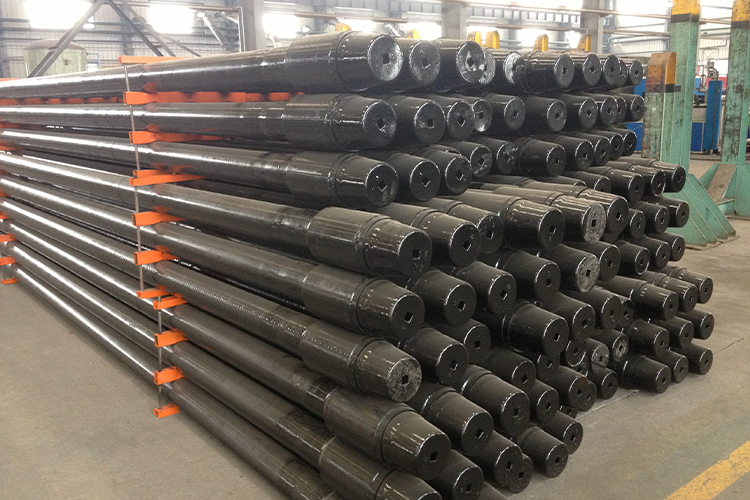
Most aftermarket drill pipe consists of three pieces that are welded together, the tube body is inertia welded to tool joints on each end. Those welds ? They are points of potential failure. “And in the kind of fatigue that hard drilling conditions generate, those welds are the weak link.”
Some of the newer one-piece forged rods hitting the market in 2026. No welding. Just a smooth upset that can do the job more efficiently.
I saw the first one piece forged rod that had gone through 2000 ft of hard rock I remember. Crisp threads still. The mating connection was as good as new. Meanwhile, the adjacent welded rod? It looked like it had gone through a shredder.
This is not a subtle difference.
The Power of Threads You Never Knew
That’s an experience I’ve learned the hard way.
I thought a thread was a thread. Whether they fit or not, does it matter?
Incorrect.
The difference between a good rod and a great one in 2026 is in the joint engineering. The best ones hit nose, shoulder and thread flanks at the same time at full torque. This spreads the load instead of localising it to a point. You are galling when the seating is inconsistent. You get cumulative shoulder wear all the way down the string.
And when the wear starts it’s like dominoes. One bad connection begets another. Pretty soon you are pulling rods mid-bore, troubleshooting problems that shouldn’t be there, and burning through your profit margin on things that were totally preventable.
The thread design innovations for 2026? They are all about consistency. Tighter production tolerances Better quality control; Thread profiles that are fast and reliable even when your crew is tired and it’s 95 degrees out.
One thing I’ve begun to ask suppliers, and you should, too is: what are the manufacturing tolerances from rod to rod? The answer tells you a lot about whether they really care about quality or just about pushing metal out the door.
Stop Trading Your Rods
This one is more of a best practice than an innovation, but it’s so important I gotta mention it.
I have seen guys mixing drill rods from different sources in the same rack. Different makers, different grades of steel, different wear to the threads. And then they ask why the string behaves badly.
If you lose the string, you lose control over how it behaves. Inconsistencies that do not show at makeup always seem to show mid-bore when they are hardest to deal with.
The smartest crews I know are? They go to one-rod standards. They clearly mark their racks. And they get used to it. That’s not red tape, that’s about protecting your productivity.
Wave of Automation
Automated drilling is probably something you’ve heard of, but 2026 is the year it’s actually becoming feasible for more than just the big guys.
Take a look at TRACTO’s newly released GRUNDODRILL 20ACS. Fully automatic drilling, rod changing and rod lubrication. Can accommodate up to 144 m of twin-rod tubing. Rod types can be selected and changed from the operator interface itself.
And it’s not just the big rigs. Much R&D has been put into automatic rod-changing systems for the rear of HDD machines, especially for mining applications. These systems include multi-degree-of-freedom rod feeding manipulators, constant pressure floating drill pipe threading manipulators and electro-hydraulic control systems.
The bottom line? Less manual work, faster rod changes and way less room for human error.
I saw a demo of one of these systems earlier this year. The operator hardly touched a thing. The machine just… did it. Rods fed, connected, drilled, disconnected and racked. And the guy was sitting there drinking coffee.
Meanwhile I remember the old days of switching rods. Two guys wrestling pipes, sweating through their shirts and dropping one on their foot now and then.
Progress, dude. It’s real.
Don’t Think Cost-Per-Stick, Think Cost-Per-Foot
Here’s the biggest change in mindset I’ve seen in 2026.
Contractors in years past would buy the cheapest rod that fit. Same thread, same diameter, lowest price arrives on time. And then they would wonder why their jobs were full of surprises . “
But here’s the thing: a rod that technically fits is not the same as a rod that performs. The difference is in the consistency of the connections under torque, the predictability of the steering through different ground conditions and how often your crew loses time to avoidable problems.
“The smart buyers in 2026 are looking at cost-per-foot across the whole job cycle. They’re taking into account expected wear life, fatigue life, risk of lost time due to inconsistent connections, and all the fieldwork friction that doesn’t show up on the invoice.
A rod that costs more per stick can actually be cheaper per foot if you consider longevity and reliability of the connection over a whole season.
I’ve seen contractors save thousands of dollars by paying a little more upfront for better rods. And I’ve seen others lose way more than that trying to save a few bucks on the front end.
What this means to you
Look, I’m not here to tell you what to buy. “That’s not my job. Every operation is different.
But what I will say is this: the drill rod landscape in 2026 is nothing like it was just two years ago. The alloys are superior. The manufacturing is more precise. Automation works. And the way that smart contractors think about their rod buys has completely changed.
My suggestion? Take a good hard look at what you really have on your rack now. Ask yourself, “Are these rods working for me or against me?
Because the innovations that are out there in 2026? This is not mere marketing hype. They’re solving actual problems real crews face every single day.
The problem I had in 2023, stuck under that intersection staring at a bent rod wondering how my day had gone so wrong.
SHARE:
More Posts for You
- Machine Learning for Prediction of HDD Drill Rod Failure – What is Possible?
- How bad can a dogleg be ? HDD drill rod fatigue : what are the safe limits ?
- HDD Drill Rod Steel Price Impact on Costs: 2026 Market Outlook
- OEM vs Aftermarket HDD Drill Rods: Warranty, Liability & Performance
- How a Bent Sub or Worn Saver Sub Impacts Your Whole Drill Rod Inventory
- How Much is Your Old HDD Drill Rod Worth for Scrap? (Current Pricing Knowledge)
- 7 Deadly Sins of Handling HDD Drill Rods: Dropping, Dragging, Over-Speeding
- Urban Utility Drilling: Why Shorter, Stiffer HDD Drill Rods Are Often Better