HDD Drill Rod Thread Damage: Prevention, Inspection & Repair
Alright, let’s do it. So get yourself a cup of coffee or whatever it is you drink and let’s talk about something that keeps me up at night. And probably keeps you up, if you’re running a rig.
The Scar That Educated Me More Than Any Textbook
I’ll never forget my second year in the business. I was green, I thought I knew everything because I could read a torque spec sheet. We were on a job on some pretty bad ground. Rocky, unforgiving, the kind of stuff that eats tooling for breakfast. The customer was breathing down our necks, the hdd rod handler was new and the pump pressure was creeping up. He was excited. You know the kind.
Anyhow we made the connection he gave it that one extra grunt with the tongs because he wanted to be sure and we started drilling. Twenty minutes later we pulled back to add another joint and the threads looked like they’d been through a war. Galling, smearing, all that. Forget the rod. My boss wasn’t happy, the customer was less happy and I had a long quiet drive home that evening.
That was my lightbulb moment. This was more than a torque wrench. It was about all the other stuff we weren’t paying attention to.
The “Oops” That Can Cost You a Bundle (and Your Sanity)
Let’s face it. Usually thread breakage is not a big dramatic thing. It’s death by a thousand papercuts. Or in our world death by one bad makeup, one missed clean, one ‘it’ll be fine’ moment.
In my book, the #1 culprit? Dirt. Nothing else. That black greasy abrasive paste that gets packed into the pin and box threads. I’ve seen guys wipe the connection with their glove and get away with it. Man, that just bugs me. Compress that “clean” surface under 15,000 psi and it feels like sandpaper. You’re not welding steel, you’re grinding two pieces of metal together with a slurry of abrasives in between.
The second silent killer is bad tong technique. “This is not a powerlifter competition. It’s about finesse. I’ve seen crews swinging on the pipe like they are trying to start a lawnmower from the 1950’s. All that does is to strain the shoulder and to make the threads bite unevenly. You get that little spiral of metal that just peels off the crest, that’s the beginning of the end. That’s the thread telling you it’s about to give up on life.
What is the Plan of Action?
Look, I’m not trying to preach. I’m here to tell you what I tell my best customers, the ones that never have to call me crying about a broken rod.
- Cleanliness is not optional, it is a religion.
You have to be religious about cleaning threads. And I don’t mean a little puff of air. I mean a real wire brush, not the cheap one from the hardware store. Use the proper brush, the proper size, the proper bristles. And the real MVP: a clean lint-free rag. Wipe the box. Clean the pin. Look at that rag. Do you see the black? Then it’s not pure enough. Do it again. “I’d rather you spend an extra couple of minutes now than two hours of downtime later.” Trade-off simple. - The ‘grease griddle’
This is my little secret. I named it the grease griddle. You know some guys just slop the thread compound on like they’re frosting a cake? That’s too bad. And indeed it can create problems – hydraulic lock, high breakout torque. You want a nice thin coat even on the pin threads. That’s all. When you stab the box it will get what it needs. Focus on the pin, brush it in, don’t just dump it on. It is there as a lubricant for the threads during make-up, not to fill the gaps. It’s not caulking.
The Art of the “Feel”
That’s where experience comes in, and that’s a hard thing to teach.” But I can give you a rule of thumb: stop when it feels “solid,” not “wrenching.”
When you push the pin into the box it should go in smooth, most of the way by hand. If you’re fighting it from the get-go, something’s wrong. Now hold on a second. Don’t push it. Take it apart, check the threads, check for nicks. That ‘solid’ feeling you get in the last few turns – that’s the shoulder seat. That’s your cue.
Now, for God’s sake, use a torque wrench. No guessing. Your breakout torque is a talk. It tells you how the joint feels. If it’s going up and up and up in the job, that tells me your threads are wearing out, your grease isn’t doing its job, or you’ve got a burr that’s getting worse. Listen to what the steel is saying to you.
So, You Have a Nickname. Now What?
Ah, the small dents. It happens. It’s quite a fight out there. You’re not going to get a clean thread forever. But the way you handle that nick is what separates finishing the bore and fishing a broken rod out of the hole.
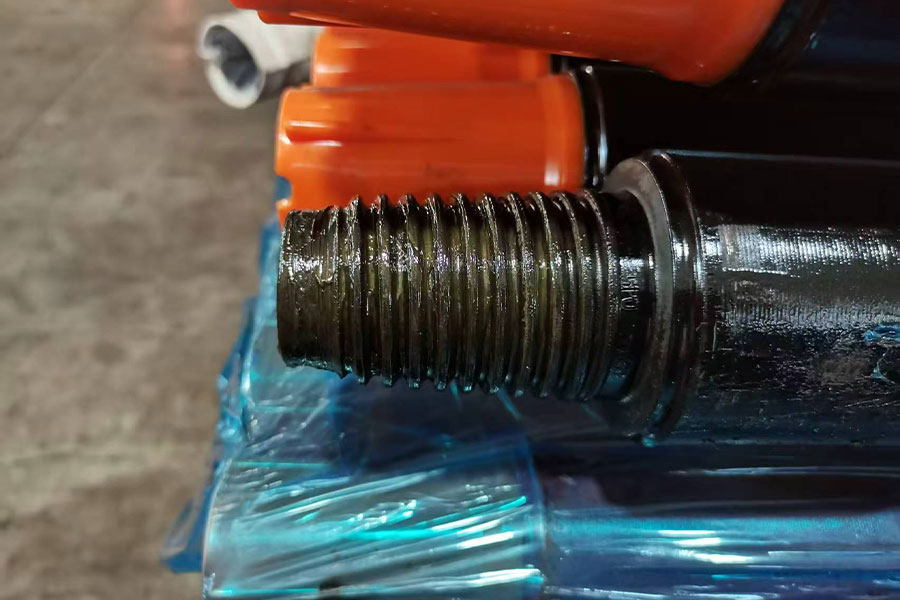
If you see a little burr, a little bit of raised metal, for heaven’s sake don’t ignore it. But also don’t get a grinder. I saw a guy do that one time. He “fixed” a burr by grinding off the thread crest with a die grinder. He created a stress riser that turned into a full blown crack on the next job. That’s a noob mistake.
Get a file thread. A good fine-tooth thread file. And learn to use it. File it along the angle of the thread, not across it. You are trying to get that little piece of metal to go back into place or come out cleanly. Not to cut a new thread profile. It’s a manicure, not a construction project.”
The Last Word: No Heroics
My number one piece of advice? Be humble with your drillpipe. “It’s the backbone of your business.” The ground is abused enough, don’t abuse it on the surface too.
In my last crew, we used to say, “Every connection is a marriage.” You respect it, keep it clean, talk nice to it, know when to walk away. Because a divorced rod—one that’s cracked, galled, or just plain worn out—costs plenty. It’s expensive to replace, it’s expensive to fish out, and it’s expensive to your reputation.
So next time you’re on the drill floor, take a moment. Check the pin like you are looking for a lost contact lens. Clean it up like your mum was coming over to inspect it. Don’t make it up with force, make it up with conviction. Your drill string will thank you, your wallet will thank you, and hey, you may even get home early.
Now go drill something. And maybe call me when you need new rods—I’ll make sure you get the good ones.
SHARE:
More Posts for You
- Machine Learning for Prediction of HDD Drill Rod Failure – What is Possible?
- How bad can a dogleg be ? HDD drill rod fatigue : what are the safe limits ?
- HDD Drill Rod Steel Price Impact on Costs: 2026 Market Outlook
- OEM vs Aftermarket HDD Drill Rods: Warranty, Liability & Performance

- How a Bent Sub or Worn Saver Sub Impacts Your Whole Drill Rod Inventory
- How Much is Your Old HDD Drill Rod Worth for Scrap? (Current Pricing Knowledge)
- 7 Deadly Sins of Handling HDD Drill Rods: Dropping, Dragging, Over-Speeding
- Urban Utility Drilling: Why Shorter, Stiffer HDD Drill Rods Are Often Better