How Many Feet Can You Bore Before Your HDD Drill Rods Pay for Themselves?
So let me start with a confession. I’ve been selling HDD drill rods for about five years now and for the first two years of that I absolutely hated the question in the title.
“How many feet before they pay for themselves?”
Every time a customer asked me that my stomach would tighten. Because I knew they wanted a nice neat number. 1,500 ft. 2,200 ft. Something they could write on a white board and show the boss.
And I would always mumble something like, “Well… it depends on the ground…” and watch their eyes glaze over.
I was technically correct. Still, I was also completely useless.
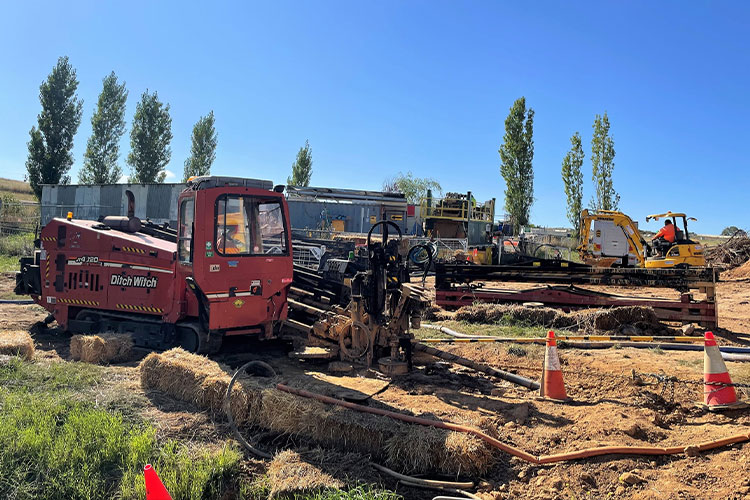
It wasn’t until one rainy Tuesday afternoon in Ohio, next to a muddy rig and a guy named Dave who’d been running HDD rigs since I was in middle school, that the truth dawned on me. That’s when I had my little “aha” moment, not from a spreadsheet but from a broken rod that snapped right at the box connection and the look on Dave’s face when he realised his “cheap” rods just cost him two full days and a $4,000 fishing job.
So let’s talk about that payback period. But do it like we’re standing around a pickup’s tailgate, not sitting in a boardroom.
The Number You Really Want (And Why I Won’t Tell You)
Okay, fine. You want a ballpark? For most medium-duty municipal work in mixed ground (clay, some sand, a little gravel, for example), if you are running a 40,000-lb class rig and you are buying a mid-tier set of 15-foot rods at around $180-220 each, you will usually see your investment come back somewhere between 1,800 and 2,500 bore-feet.
But here’s the catch: that number doesn’t really mean anything. And I’ll tell you why.
A real sharp guy from Texas, a great guy, bought a set of our economy rods because he was on a budget. He did the math. Two thousand feet of bore. Rods paid off. Easy. Six weeks later he calls me, not happy. He had gone only 1,400 feet when he had to pull the string, for three rods had developed hairline cracks at the pin.
His chance for payback? Never. For those rods never lasted long enough to earn their salt. He saved $40 a rod up front and lost about $3,000 in downtime, crew wages and a tool rental for fishing.
That was my first proper lesson. Payback isn’t measured in feet. It’s about the survival rate.
The day I stopped selling cheap and started selling smart.
“I can never forget that conversation that changed my thinking. Dave, the Ohio guy I told you about, was on-site with me and he was running the same set of our premium rods for the third season. “How many feet you got on these?” I asked him.
He shrugged his shoulders. “No idea. Maybe 12,000? 13,000? “I lost track.”
I nearly dropped my clipboard. The rods had cost him some 25% more than the “budget” set he used to buy. But here’s the kicker: he told me he thought they paid for themselves in somewhere in the first 1,200 feet of the very first bore. Not for the magic of it, but for the fact he never had to stop. No wobble, no galling, no broken pins. The crew just kept on going.
And then it hit me – payback period is not a distance. This is a risk threshold.
Once your rods go past that first 1,500–2,000 feet without a major failure, they are not just paying for themselves. They buy your peace of mind. And trust me, I know peace of mind is worth real money, I’ve been next to enough guys with fishing magnets and spiral extractors.
What Really Kills Your Payback (Spoiler: It’s Not the Rods)
One thing I wish someone would have told me when I started is that most drill rods don’t die of old age. They die.
By operator. By the mud! On the floor. By the guy who thought “torque” was a suggestion
I had a customer down in Florida, a nice guy, ran a little crew, who kept bending pins on our rods. He called me in a huff, thinking we had sold him a bad batch. I drove out there and watched his crew for about forty-five minutes and I could see the problem right away. His operator was working the rig like he was mad at the ground. Too much down pressure, way too much rotation speed and for the first few seconds of each connection he was spinning the rods with no fluid flow.
That is like starting your car and redlining it before the oil gets around.
We fixed the technique and guess what? That same set of rods went on to do 8,000 feet with no problem. By simply changing his technique with the tool, he reduced his payback period from “never” to “about 1,600 feet.”
So if you ask me the payback question I’m going to ask you one back, what is your crew’s connection routine like? Because that one factor changes your ROI more than any steel chemistry ever could.
Some Math That Helps
All right, I’ll give you numbers. But only because we’re friends, and I know how you like to run the books.
Say you buy a 300-foot string of rods at $200 each. That comes to an investment of $6,000.
Say your day rate for a 40k rig with crew is $1200 an hour. Those rods thread faster, don’t gall and handle better. If they save you just one hour of downtime a week, that’s $1,200 a week. You’ve paid for the rods in five weeks. That’s about 200 feet a day, in five weeks, around 5,000 feet of bore.
But if they save you from ONE fishing job – average cost is about $2,500–4,000 depending on depth and tooling – then your payback just dropped to maybe 1,200 feet. Because that cost saved counts too.
See what I mean? It’s not just about feet you drill. It is about the feet you don’t have to drill two times.
My honest advice after 5 years in the mud
Here’s what I would tell my younger self if I was a new buyer:
Don’t buy on price. Shop on consistency.
I have seen $160 rods outfish $250 rods in soft clay and $300 rods snap like twigs in gravelly cobble. The secret is not in the brand. It’s the heat treat, the thread design and the quality of the factory inspection on each joint. I’ve been in our own plant and watched our QC guy reject a whole batch because the hardness was off by 2%. That’s the boring, unsexy stuff that actually pays your rods back faster.
And please – for the love of all that is holy – rotate your rods. Don’t run the same 3 rods in the front all day. Flip them over. Mark them. Follow them. I have a customer in Colorado that numbers every rod and logs what position it ran in. He gets 15,000 feet out of sets that most guys blow out at 6,000 feet. How long before he gets his money back? He told me he didn’t care after the first week.
So, What’s the Real Story?
So after all this rambling, here’s my real unfiltered been-in-the-trenches answer:
Usually somewhere between 1,500 and 3,000 bore-feet is where most good-quality HDD drill rod will pay for itself, assuming you are in average ground and your crew is not actively trying to destroy them.
But if you treat them right – good connections, proper mud flow, reasonable rotation speeds – and if you buy from a manufacturer that actually cares about straightness and thread concentricity, you’ll see that number drop to something closer to 1,000 feet. And then each foot is a bonus.
I’ve had customers tell me that their rods paid for themselves in the first 800 feet by avoiding one stuck-pipe incident that would have cost them a whole weekend and a rental crane.
So don’t get hung up on the number. Be obsessive about the habits. The feet will look after themselves.
One Final Tale Before You Depart
Had a guy call me last year. Older fella, been drilling since the 90s. He said, “Son, I been buying your rods for three years. “I don’t know how many feet I’ve drilled.” I don’t care. All I know is, “I haven’t had to call a fishing crew since I switched.
That’s when I learned: the payback period is not a financial calculation. It’s maths sleep.
How many nights do you want to stay awake worrying about that 2:00 AM phone call? Buy the rods to sleep. And I promise you, the feet will pay for themselves before you know it.
Okay, that’s my rant. Go drill something, and for God’s sake, lube up those threads.
SHARE:
More Posts for You
- Machine Learning for Prediction of HDD Drill Rod Failure – What is Possible?
- How bad can a dogleg be ? HDD drill rod fatigue : what are the safe limits ?
- HDD Drill Rod Steel Price Impact on Costs: 2026 Market Outlook
- OEM vs Aftermarket HDD Drill Rods: Warranty, Liability & Performance
- How a Bent Sub or Worn Saver Sub Impacts Your Whole Drill Rod Inventory
- How Much is Your Old HDD Drill Rod Worth for Scrap? (Current Pricing Knowledge)
- 7 Deadly Sins of Handling HDD Drill Rods: Dropping, Dragging, Over-Speeding
- Urban Utility Drilling: Why Shorter, Stiffer HDD Drill Rods Are Often Better