One-Piece Forged vs. Welded HDD Drill Rods: What’s the Difference?
And why I stopped losing sleep over broken strings
Hey team Frank here.
Bring a chair. Or better yet, lean on your rig for a minute while the mud pump does it’s thing. I want to tell you something that took me way too long to learn.
I have been selling HDD tooling for the last five years. Work right in the mill, see rods being made, talk to guys like yourself who come in with mud-caked boots and a tired look. And my first two years? I honestly thought a drill rod was just a threaded steel pipe. You buy it, you spin it, you yank it back. End of the story.
Yeah. That was the thing that bit me back.
My “Oh Shit” Moment for HDD Drill Rods (aka how I learned to get into forging)
Let me take you back to a job site about 2 years ago.
A regular customer phones me; we’ll call him Dave. His voice has that particular kind of frustration. You know what I mean. The kind where he’s already pulled three rods from the dirt and wiped mud off his face twice.
“Frank,” he says. “Now the threads are chafing again. 3rd rod this month Same place – where the pipe meets the end. I’m losing money.”
I picked up my hard hat and drove out. Dave’s crew was pulling around 400′ in sandy clay. Nothing insane. No boulders. No surprise rock shelf. But I saw them get a rod out that had just come out of the bore – I saw it.
Right there at that little ring where the threaded end is welded to the tube body, there was a little wiggle, almost invisible. Like a wiggly tooth. And the threads? They were no longer round. They looked like they’d been hit with a hammer.
That was my “oh shit, moment”. I discovered that I had been selling both types of rod, welded and one-piece forged, without really knowing why one kept breaking and the other didn’t.
So I went back to the factory and got our senior forging guy and had him explain it to me like I was five years old. This is what I found.
Welded Hdd Drill Rods: the Cheap Mate Who’s Never There at 2am
Let’s be fair. Welded rods are not evil. They’re just built different, man.
Their making: You take a length of seamless steel tube. Then you take two fake ends (the parts with the threads). You spin them really fast, you jam them together with a lot of pressure – that’s friction welding – and boom, you have a drill rod.
Sounds alright right? And a lot of jobs it’s fine.
Where welded rods are effective:
Small diameters (4-6 inches)
Short pulls under 300 feet
Soft, forgiving ground (sand, loam, ordinary dirt)
Jobs where you could actually lose a rod down a hole (rocky ground with cavities, say)
What for? If you lose a welded rod, you cry a little but you’re only out maybe 200 bucks. It’s painful, but it won’t ruin your week.
The issue nobody talks about:
That friction weld leaves a “heat-affected zone” – a thin band of metal right next to the weld. The heat alters the grain structure of the steel. It gets stiffer. More rigid. More brittle with time.
Now just imagine what every single pull is doing to your drill rod. It flexes. It follows the curves. It spins with torque. And what does the flexing focus on? At the border of that stiff zone. The weld itself is sound. But the space besides it? That’s the soft part.
I’ve seen rods break after welding, right there after maybe 8,000 feet of cumulative drilling. Not because the weld failed – but because the metal right next to it just got tired.
And the kicker is you don’t see it coming. No warning. One day is fine. The next day, pop, you are fishing.
One-Piece Forged HDD Drill Rods: The Dependable (But Boring) Hero
Let me tell you about the other kid in class.
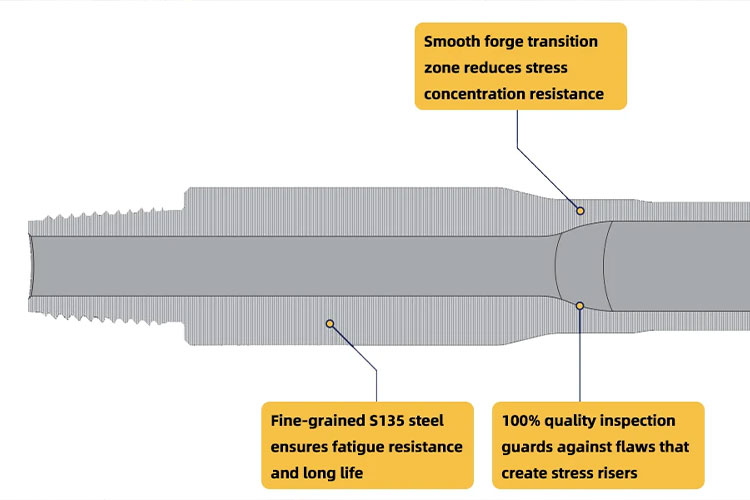
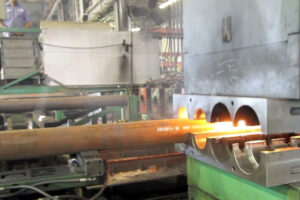
One-piece forged rods start out as a solid bar of steel—called a billet. That billet is heated until it glows orange and then a giant forging press pounds it into shape. All is made from one solid piece of metal – the threads, the tube body, everything. No welds. No needlework. No ‘let’s hope this joint don’t break.’
Why it matters when you’re 400 feet under a parking garage:
The steel grain in a forged rod runs around the threads and up and down the tube. It has the grain of a piece of wood. If you have ever split firewood, you know it splits along the grain – not across it. Forged rods have a continuous grain flow so there is no sudden change in the stiffness. The whole thing bends evenly when the rod bends.
This means there’s less stress concentration. Less annoying. Less surprises.
The “aha” moment on the Dave’s job site:
I pulled all his welded rods out and put in a set of our one-piece forged rods. Same rig, same ground, same pull-back force.
Two weeks later Dave called me up. I was expecting another complaint. Instead he sounded almost bored. “Frank, they just… working. No threading issues. No wobbling. I don’t have to think about them.”
And that was the eureka moment – the best tool is the one you don’t think about. Dave had to call me every week, with welded rods. He was able to get home with forged rods.
Real Talk: How Long Do Forged HDD Drill Rods Last?
I’m not going to shoot fake numbers at you. Each job site is unique.
But here’s what I’ve seen in five years of tracking our rental fleet and customer returns:
Welded rods medium duty (6,000-8,000 lbs pull back, mixed ground) Usually need thread repair or show cracks around 15,000-20,000 total drill feet.
One piece forged rods, same conditions: 40,000-60,000 feet before they even start to complain.
‘Well, forged rods cost more upfront, say 30-40% more than a good welded rod. But over the lifetime of the stick? You are getting one forged set instead of three welded sets. And you’re not paying your crew to pull broken rods out of a borehole at 4pm on a Friday.
I would take that trade every time.
When I Personally Still Use Welded Rods (Yes, Even Me)
Look, I’m not a snob. I don’t get up on a soapbox and shout “forged or nothing”. That would be foolish.
I still have a set of welded rods on the rack for specific jobs:
Rocky nasty ground where I could lose a rod anyway. If there’s a reasonable chance I’m never seeing that rod again, I’d rather lose a $200 welded rod than a $350 forged one.
Short, straight hauls under 250 feet. Why use a top rod for an uneventful shot?
Training new guys. Let them learn to make and break joints on cheap rods. When they f*ck up threads (and they will) it hurts less.
But anything over 6,000 lbs of backfire? Anything round? Any job you can’t afford to be down? Forged all the day long.
One More Story (And I Just Can’t Help Myself)
Another customer we had was a big outfit, maybe 15 rigs. They always purchased welded rods from a major catalogue brand. I didn’t even try to sell them. Just asked if I could come watch a bore.
The foreman took me to see their “rod graveyard” – a pile of perhaps 40 welded rods, all cracked in the weld zone. He shrugged, “That’s just the cost of doing business.”
I asked him, “What if you spent 35% more per rod, but only replaced every 3 years instead of every year?
He said nothing. He simply stared at the pile.
Six months later he called me with a quote on forged rods. Ordered 200 pcs . That was three years back. Since then he’s bought more, but not because the old ones wore out, but because he added more rigs.
That’s the kind of “cost of doing business” I like to see.
So What Should You Get About the Rods?
I’m not gonna give you some slick sales answer. You know your ground. Your crew. Your budget.
But here is my plain-spoken, muddy-boots advice:
If you… Then begin with…
Welded. Short shots, small diameters, or rocky holes where you might lose rods Nothing to be ashamed of. Save that money for something else.
Do long bores, curves, higher torque, or any job w/ high dollar reaming toolsOne piece forged. Invest a little more now sleep better tonight.
And never know what ground you’ll hitBuy a couple of forged rods for the front of the string, that’s where the stress is the worst. Run welded after them. Hybrid setups are good.
And if you still aren’t sure? Call me. Really? “I’m the factory guy that answers the phone. I will ask you about your last three jobs and look at your pictures and tell you what I would buy if it was my own money.
No Bull Shit. Bars only.
- My “Oh Shit” Moment for HDD Drill Rods (aka how I learned to get into forging)
- Welded Hdd Drill Rods: the Cheap Mate Who’s Never There at 2am
- One-Piece Forged HDD Drill Rods: The Dependable (But Boring) Hero
- Real Talk: How Long Do Forged HDD Drill Rods Last?
- When I Personally Still Use Welded Rods (Yes, Even Me)
- One More Story (And I Just Can't Help Myself)
- So What Should You Get About the Rods?
SHARE:
More Posts for You
- Machine Learning for Prediction of HDD Drill Rod Failure – What is Possible?
- How bad can a dogleg be ? HDD drill rod fatigue : what are the safe limits ?
- HDD Drill Rod Steel Price Impact on Costs: 2026 Market Outlook
- OEM vs Aftermarket HDD Drill Rods: Warranty, Liability & Performance
- How a Bent Sub or Worn Saver Sub Impacts Your Whole Drill Rod Inventory
- How Much is Your Old HDD Drill Rod Worth for Scrap? (Current Pricing Knowledge)
- 7 Deadly Sins of Handling HDD Drill Rods: Dropping, Dragging, Over-Speeding
- Urban Utility Drilling: Why Shorter, Stiffer HDD Drill Rods Are Often Better