The Backbone of the Bore: A Guide to HDD Drill Pipe Classification and Selection
Horizontal Directional Drilling (HDD) is a engineering marvel, allowing us to install vital utilities underground with minimal surface disruption. But while the drilling rig often gets the spotlight, the true unsung hero of any HDD operation is the drill pipe.
Think of the drill string as the project’s circulatory system. It transmits rotation, thrust/pullback force, and drilling fluid to the downhole tool. Choosing the right drill pipe isn’t just a matter of specification; it’s a critical decision that impacts the efficiency, safety, and success of your entire bore.
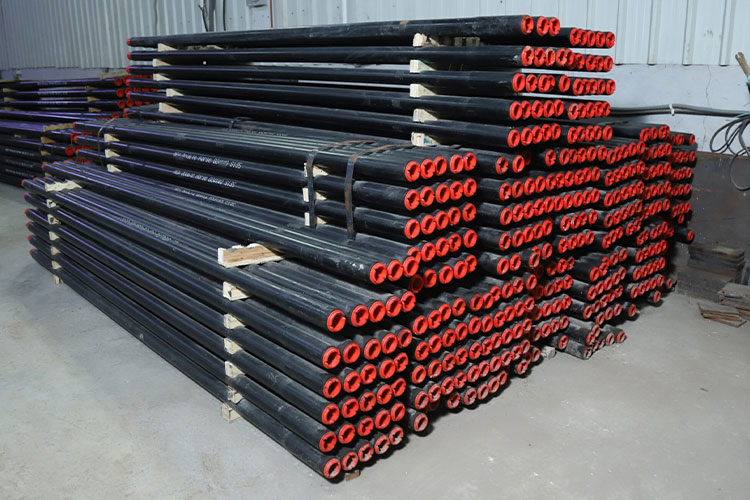
In this guide, we’ll break down the primary classifications of HDD drill pipe and their ideal application scenarios.
Classification 1: By Weight and Duty Rating
This is the most common way to categorize HDD drill pipe, directly relating to the power of the rig and the demands of the project.
1. Standard Weight (or Standard Duty) Drill Pipe
- Characteristics: This is the workhorse of the HDD industry. It features a relatively thin wall, making it lighter and more flexible. It’s designed for smaller to mid-sized rigs.
- Typical Size Range: 2-7/8″ to 5″ OD (Outside Diameter).
- Ideal Applications:
- Short to Medium Crossings: Utility installations for fiber optics, gas lines, and water lines under roads, small rivers, and parks.
- Soft to Medium Soils: Excellent performance in clay, silt, and stable sand.
- Pilot Hole Operations: The standard choice for the majority of pilot boring activities.
2. Heavy Weight (or Heavy Duty) Drill Pipe
- Characteristics: As the name implies, this pipe has a thicker wall, providing greater tensile and torsional strength. It is less flexible but can handle significantly higher stress.
- Typical Size Range: 3-1/2″ to 6″ OD and larger.
- Ideal Applications:
- Longer Crossings and Large Diameter Pullbacks: Essential for pulling heavy product pipes like steel casings or large-diameter HDPE.
- Challenging Geologies: Necessary when drilling through rocky, abrasive, or unpredictable formations where torque and stress spikes are common.
- High-Power Rigs: Used with large mid-range and big rigs (e.g., 300,000+ lb pullback capacity).
3. Extra Heavy Weight (X-High Strength) Drill Pipe
- Characteristics: This is the specialist pipe built for the most extreme HDD projects. It has the thickest walls and is manufactured from the highest-grade alloys to withstand immense forces.
- Typical Size Range: 4″ to 6-5/8″ OD and larger.
- Ideal Applications:
- Major River Crossings: Mega-projects crossing wide rivers like the Mississippi or major shipping lanes.
- Extended-Reach Bores: Pushing the limits of bore length-to-depth ratios.
- Extreme Conditions: Drilling through very hard rock (granite, basalt) or in high-stress environments where pipe failure is not an option (e.g., under critical infrastructure or environmentally sensitive areas).
Classification 2: By Tool Joint Connection
The threaded connections at the end of each pipe are critical failure points. The type of connection determines how efficiently force is transferred.
1. Friction Welded Tool Joints
- Characteristics: A separate, hardened steel tool joint is welded onto the pipe body. This is the industry standard for most HDD applications. The weld is incredibly strong and reliable.
- Ideal Applications: The go-to choice for almost all Standard and Heavy Weight drill pipe. It provides an excellent balance of strength, durability, and cost-effectiveness.
2. Integral Tool Joints
- Characteristics: The tool joint threads are cut directly into the pipe body itself, with the pipe’s wall thickness being increased at the end to accommodate the threads. There is no weld.
- Ideal Applications:
- Small-Diameter Pipe (e.g., 2-7/8″): Common where a friction weld is not practical.
- High-Cycle Fatigue Applications: The lack of a weld zone can sometimes offer better fatigue resistance in certain demanding, high-cyclic loading conditions.
Classification 3: Specialized Pipe Designs
Beyond standard classifications, some pipes are designed for specific challenges.
1. Double-Wall (Dual-Wall) Drill Pipe
- Characteristics: Features an inner and outer pipe, creating an annular space for fluid flow.
- Ideal Applications:
- Air Drilling / Misting: The primary fluid (air) is sent down the annulus, while a smaller amount of misting fluid can be pumped down the inner string. This is highly effective in certain geologic formations.
2. Non-Magnetic Drill Pipe
- Characteristics: Made from non-magnetic alloys (e.g., austenitic stainless steel).
- Ideal Applications:
- Walkover Locating Systems: Essential when using a magnetic steering tool (magnetometer) inside the drill string. The non-magnetic pipe prevents interference, allowing for accurate tracking of the drill head.
Choosing the Right Pipe: A Quick Guide
- For a 200 ft fiber optic bore under a park: Standard Weight pipe is perfect. It’s cost-effective and provides more than enough strength.
- For a 2,000 ft river crossing pulling a 24″ steel casing: You’ll need Heavy Weight or Extra Heavy Weight pipe to manage the immense pullback forces and torque.
- When drilling in dense rock with a high-power rig: Heavy Weight pipe with robust, friction-welded tool joints is the minimum requirement.
- When your locator can’t get a signal: A section of Non-Magnetic pipe might be needed directly behind the drill head.
Conclusion
In HDD, there is no one-size-fits-all solution. Your drill pipe is your direct link to the downhole environment, and its selection is a fundamental part of bore planning. By understanding the classifications—Standard, Heavy, and Extra Heavy Weight—and the nuances of their connections and special designs, you can match your equipment to the project’s demands. This ensures not only a successful bore but also maximizes the lifespan of your valuable drill string and, most importantly, keeps your crew and the environment safe.
SHARE:
More Posts for You
- Machine Learning for Prediction of HDD Drill Rod Failure – What is Possible?
- How bad can a dogleg be ? HDD drill rod fatigue : what are the safe limits ?
- HDD Drill Rod Steel Price Impact on Costs: 2026 Market Outlook
- OEM vs Aftermarket HDD Drill Rods: Warranty, Liability & Performance
- How a Bent Sub or Worn Saver Sub Impacts Your Whole Drill Rod Inventory
- How Much is Your Old HDD Drill Rod Worth for Scrap? (Current Pricing Knowledge)
- 7 Deadly Sins of Handling HDD Drill Rods: Dropping, Dragging, Over-Speeding
- Urban Utility Drilling: Why Shorter, Stiffer HDD Drill Rods Are Often Better