Applications of Hole Openers in Horizontal Directional Drilling (HDD) Projects
In HDD projects, the Hole Opener (or Reamer) is a critical downhole tool primarily used during the backreaming phase. Its core function is to enlarge the pilot hole to a final diameter suitable for product pipe pullback.
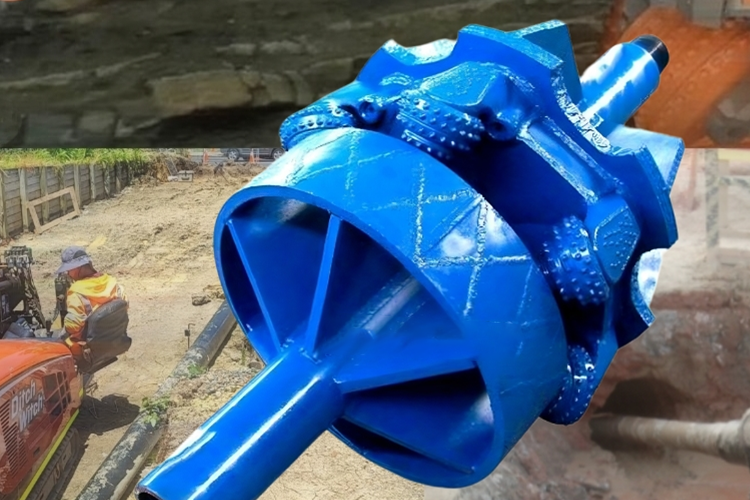
Primary Application Scenarios
- Mandatory Backreaming Prior to Pullback
- Standard Procedure: This is the most fundamental and universal application. After successfully drilling the pilot hole (typically 100-200mm in diameter), it is too small to accommodate the product pipe (e.g., a DN500 PE pipe may require a ~650mm hole). The hole opener is used for one or multiple stages of reaming to enlarge the bore to the design diameter (usually 1.2 to 1.5 times the pipe diameter).
- Adaptation to Various Ground Conditions
- Soft Soils/Clay Layers: Floating Cutter or Drag-Type Reamers are used. Their blade structures efficiently cut and mix soil, creating a uniform slurry mixture for easy removal.
- Hard Clay, Sand, Gravel Layers: Carbide Insert or Block-Type Reamers are preferred. Their rugged tungsten carbide inserts crush and cut through harder, abrasive formations.
- Composite or Hard Rock Formations: Roller Cone (Rock) Reamers are employed. Independently rotating cones fracture rock through impact and crushing, suitable for the toughest and most variable strata.
- Complex Process Requirements
- Hole Cleaning & Conditioning: After the final ream, a slightly larger “Washing Reamer” or “Barrel Reamer” is often run. This smoothes the bore wall, removes residual cuttings, and ensures the drilling fluid is homogeneous, creating optimal conditions for pullback and significantly reducing the risk of getting stuck.
- Staged / Progressive Reaming: When the final hole size is significantly larger than the pilot hole (e.g., from 200mm to 900mm), it cannot be done in one pass. Following the “rule of thumb” (do not increase hole diameter by more than 50% per pass), hole openers of progressively larger sizes are used for multiple reaming passes to manage pull force and torque and ensure borehole integrity.
Key Considerations for Selecting and Using a Hole Opener
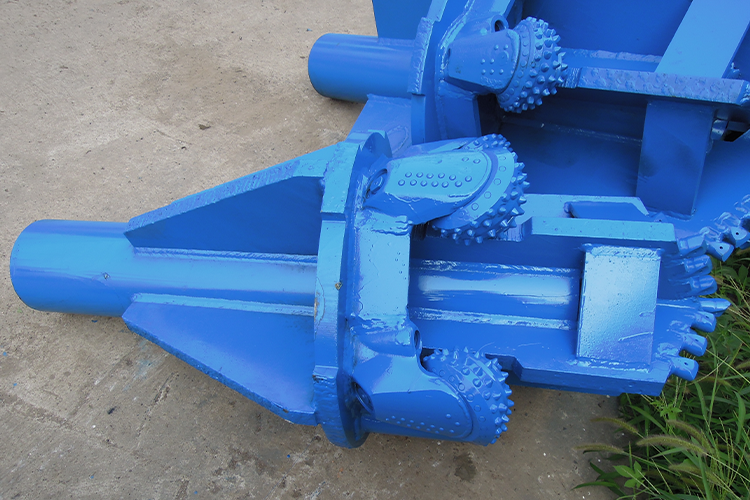
Correct selection and use are vital for project success.
| Consideration Factor | Explanation & Impact |
|---|---|
| Geology / Formation | The deciding factor. Choose the cutting structure (drag, insert, roller cone) based on the geotechnical report. An incorrect choice leads to low efficiency, severe wear, or tool failure. |
| Final Bore Diameter | Determines the reamer size and the need for staging. Final Diameter = Pipe OD × Safety Factor (typically 1.2-1.5). |
| Rig Capacity | Reamer size must match the rig’s Pullback Force and Torque output. Large reamers in hard formations require very high torque. |
| Fluids System | The reamer must be matched to the mud pump Flow Rate. Reaming generates vast volumes of cuttings, requiring sufficient, high-quality drilling fluid for removal, tool cooling, and borehole stabilization. Poor fluid performance is a primary cause of bore collapse and stuck tools. |
| Connection & Drilling String | Must be compatible with the drill pipe, swivel, etc. Connections must be robust to handle high torque and load. |
| Fluid Flow Design | A quality reamer has strategically placed nozzles to ensure fluid reaches the cutting face and aids in cuttings transport. |
Integrated Scenario in a Typical HDD Workflow
- Planning: Based on the geotechnical report and design diameter, develop a reaming plan (number of stages, reamer type and size for each).
- First Ream (after pilot hole): Connect the smallest hole opener to the drill string at the exit side and pull it back toward the drill rig while rotating. Simultaneously, pump drilling fluid at the designed rate. The reamer cuts the bore wall, and fluid transports cuttings back to the entry pit.
- Progressive Reaming: Repeat the process, installing larger reamers for each stage until the final diameter is achieved.
- Hole Conditioning (Optional but recommended): Run a barrel reamer or the final reamer again at a steady pace with ample fluid to “swab” the hole clean.
- Product Pipe Pullback: Connect the product pipe to the reamer (or a specialized “pullback reamer”/”swivel”) and pull it into the enlarged hole simultaneously with the final reaming/cleaning pass.
Common Problems & Mitigation (Failure Scenarios)
- Reamer Gets Stuck:
- Potential Causes: Insufficient fluid flow leading to a cuttings bed; formation collapse; excessive diameter increase per pass.
- Mitigation: Increase fluid flow rate and viscosity; attempt to free by alternating push/pull and rotation; may require reverse reaming or excavation.
- Low Reaming Efficiency, Slow Progress:
- Potential Causes: Reamer type mismatch (e.g., using a drag reamer in rock); severely worn cutters; poor drilling fluid properties.
- Mitigation: Inspect and change to a suitable reamer; check, repair, or replace worn cutters; optimize fluid mix.
- Unstable Borehole, Surface Settlement or Fluid Inadvertent Returns (Frac-Out):
- Potential Causes: Improper fluid pressure management failing to support the bore wall; reaming too fast in loose sands.
- Mitigation: Optimize fluid for wall-cake building (e.g., add polymers); control reaming speed; ensure proper fluid return path.
Summary
In HDD projects, the application of the Hole Opener encompasses the entire process of safely, efficiently, and stably enlarging a small pilot hole to the target diameter. It is not merely a “bit” but a core tool requiring precise selection and strategic application based on geology, hole size, and equipment capabilities. The correct reamer selection and reaming program are fundamental to ensuring a smooth, one-time-successful pipe pullback and the creation of a high-quality, stable bore for the pipeline’s lifespan.
SHARE:
More Posts for You
- Machine Learning for Prediction of HDD Drill Rod Failure – What is Possible?
- How bad can a dogleg be ? HDD drill rod fatigue : what are the safe limits ?
- HDD Drill Rod Steel Price Impact on Costs: 2026 Market Outlook
- OEM vs Aftermarket HDD Drill Rods: Warranty, Liability & Performance
- How a Bent Sub or Worn Saver Sub Impacts Your Whole Drill Rod Inventory
- How Much is Your Old HDD Drill Rod Worth for Scrap? (Current Pricing Knowledge)
- 7 Deadly Sins of Handling HDD Drill Rods: Dropping, Dragging, Over-Speeding
- Urban Utility Drilling: Why Shorter, Stiffer HDD Drill Rods Are Often Better