How Does a Horizontal Directional Drill Actually Work? (A Down-to-Earth Explanation)
Let’s talk about one of the coolest pieces of equipment in our world — the Horizontal Directional Drill (HDD). If you’ve ever wondered how crews manage to slip pipes and cables underground without tearing up the street, well, grab a coffee. I’m about to walk you through it like I would on a jobsite tailgate.
It All Starts with a “Pilot Hole” — But It’s Not What You Think
My first time seeing an HDD rig in action, I honestly thought it was just a big drill pushing straight ahead. Boy, was I wrong. The real magic begins with what we call the pilot hole. Imagine trying to thread a needle, but the needle is 20 feet underground and you can’t see it. That’s the pilot phase.
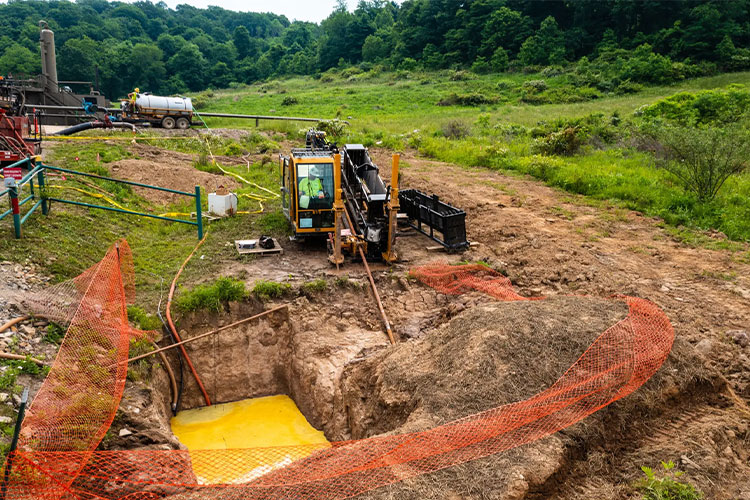
The rig pushes a small drill stem (with a angled drill head) into the ground at a shallow angle. Here’s the kicker — that head isn’t just spinning mindlessly. It’s emitting a radio signal. And above ground, a guy with a locator (like a high-tech metal detector) is following every move.
I still remember the first time I held that locator. I felt like a wizard with a magic wand, except my “spell” was yelling over the radio: “Five feet deeper… now come left two degrees!”
How Do You Steer Something You Can’t See?
This was my biggest “mind blown” moment. Steering isn’t about turning a steering wheel. It’s about finesse.
The drill head is slightly bent or angled. When the operator wants to go straight, they rotate the drill pipe. But when they need to change direction? They stop rotating, point the head in the desired direction, and just push. That angled head nudges through the soil like a slow, precise swimmer doing a underwater turn.
The locator guy (often called the “locator” or “walker”) is feeding back live GPS-like data: pitch, depth, roll, and location. It’s a constant, quiet conversation between the driller and the walker. If they’re not in sync, you can end up in someone’s backyard flowerbed instead of under the road. Not that I’ve seen that happen… cough.
The “Big Pullback”: Where the Real Muscle Comes In
Once the pilot hole breaks surface at the exit point (always a mini-celebration on site!), the “fun” part starts. Now we have a small, guided tunnel from Point A to Point B. But it’s way too small for our product pipe.
So, we attach something called a reamer to the drill string. Think of it as an underground hole-opener. We pull it back toward the rig, and it chews away at the soil, enlarging the hole — sometimes in multiple passes, depending on the size needed. Here’s where I learned to respect good drill pipe. This is the high-stress part. You’re pulling, rotating, and dealing with all sorts of underground surprises. Worn or weak pipe? That’s when you hold your breath and pray you don’t have a bad day.
The Grand Finale: Pipe Installation
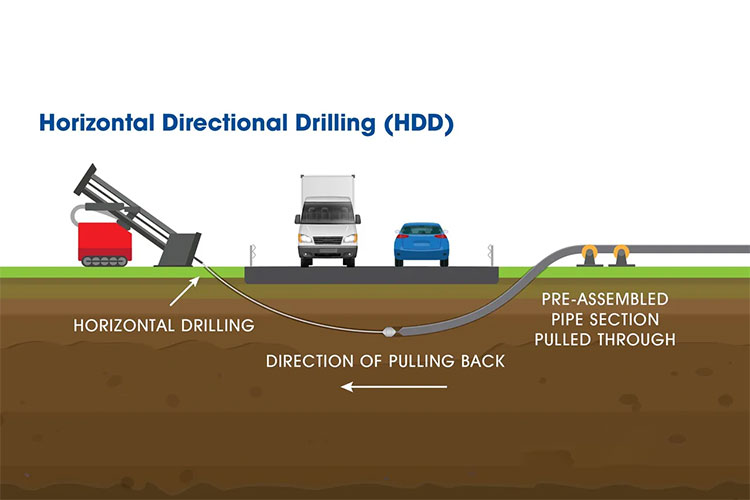
This is the payoff. Once the hole is the right size, the product pipe (fiber, conduit, gas line, you name it) is attached behind the reamer. In one continuous, smooth pull, the rig drags the whole assembly back through the enlarged hole. The pipe is born into its new underground home, without ever seeing the light of day. No trenches, no restored lawns, just a clean entry and exit point. It’s deeply satisfying to watch.
The Things Nobody Tells You (My Little Rant)
Okay, real talk. It’s not always smooth sailing. Mud matters — a lot. That drilling fluid (just bentonite clay and water, usually) isn’t just for cooling the head. It’s the lifeblood of the operation, carrying cuttings out and stabilizing the hole. Get the mix wrong, and you’ve got a sloppy, collapsing mess.
And let’s talk about “locating.” It’s not foolproof. Sometimes you hit a magnetic field or an old buried piece of metal, and your signal goes haywire. That’s when experience and good equipment save the day. I’ll never forget the seasoned locator who told me, “The tool tells you a story. You just have to learn how to listen to it.” He was right.
So, Why Do We Geek Out Over This Stuff?
Because when it’s done right, it’s a beautiful blend of tech, touch, and trust. It’s not just about making a hole; it’s about making a precise, clean, and smart path for the infrastructure we all rely on.
Next time you’re stuck in traffic, and you see an HDD rig sitting quietly off to the side, know this: there’s a team underground having a high-stakes, guided conversation with the earth. And honestly? I still think that’s pretty awesome.
SHARE:
More Posts for You
- Machine Learning for Prediction of HDD Drill Rod Failure – What is Possible?
- How bad can a dogleg be ? HDD drill rod fatigue : what are the safe limits ?
- HDD Drill Rod Steel Price Impact on Costs: 2026 Market Outlook
- OEM vs Aftermarket HDD Drill Rods: Warranty, Liability & Performance
- How a Bent Sub or Worn Saver Sub Impacts Your Whole Drill Rod Inventory
- How Much is Your Old HDD Drill Rod Worth for Scrap? (Current Pricing Knowledge)
- 7 Deadly Sins of Handling HDD Drill Rods: Dropping, Dragging, Over-Speeding
- Urban Utility Drilling: Why Shorter, Stiffer HDD Drill Rods Are Often Better